Most word puzzles look simple until you try to explain them clearly. One of the most common examples is the question, what word is the same backwards and upside down. At first, it sounds like a trick. Then you start testing words, flipping letters in your head, and realizing the answer depends on spelling, font style, and the way the word is rotated.
The most accepted answer is NOON, especially when written in capital letters. It reads the same from left to right and right to left, and when turned upside down in many simple block fonts, it still appears as NOON. That makes it both a palindrome and a rotational word puzzle. This small word opens the door to a surprisingly interesting topic involving symmetry, typography, ambigrams, classroom riddles, visual language, and why some words behave differently when seen from another angle.
The Simple Answer
The word NOON is usually the best answer to this puzzle. Written in uppercase letters, NOON reads the same backwards because the order of the letters remains identical when reversed. N-O-O-N becomes N-O-O-N again, which makes it a true palindrome.
NOON can also appear the same upside down when the letters are drawn in a clean, symmetrical style. The two O letters are naturally rotationally symmetrical, and the capital N can often survive a 180-degree turn visually. That is why NOON works better than most everyday words.
Why NOON Works So Well
NOON has the right combination of letter order and letter shape. A word must pass both tests to satisfy the riddle. It must read the same backwards, and its letters must still make sense when the word is rotated upside down.
Many words are palindromes but fail the upside-down test. Others may look interesting when flipped, but they do not read the same backwards. NOON succeeds because its spelling and visual structure support both conditions at the same time.
Key facts about the answer:
- The most common answer is NOON.
- NOON is a palindrome.
- NOON can be read upside down in many uppercase fonts.
- The result depends on letter style.
- Simple block lettering makes the puzzle work best.
- The word is short, memorable, and easy to test visually.
Palindrome Meaning in Word Puzzles
A palindrome is a word, phrase, number, or sequence that reads the same forward and backward. Common examples include civic, level, radar, madam, and refer. These words are popular in riddles because they turn ordinary spelling into a pattern.
For the question what word is the same backwards and upside down, being a palindrome is only half the job. The word also needs visual symmetry. That extra condition makes the puzzle more selective than a standard palindrome challenge.
Upside-Down Word Meaning
An upside-down word is usually a word that still looks readable after being rotated 180 degrees. This is different from looking at a word in a mirror. A mirror reverses left and right, while rotation turns the entire word upside down.
In visual puzzles, upside-down readability depends heavily on typography. A handwritten N may not rotate cleanly, but a block-style N often does. This is why puzzle answers usually assume capital letters and simple printed forms.
Palindrome vs Ambigram Comparison
Palindrome and ambigram are related, but they are not the same. A palindrome is based on letter order, while an ambigram is based on visual appearance. NOON is interesting because it can behave like both under the right conditions.
Comparison table:
Feature | Palindrome | Ambigram
Meaning | Reads the same backward | Looks readable after rotation or reflection
Main focus | Spelling order | Visual design
Example | civic | SWIMS in some fonts
Best match for this puzzle | NOON | NOON or SWIMS depending on interpretation
Depends on font | Usually no | Yes, often strongly
The Role of Letter Symmetry
Letter symmetry is the main reason some words survive being flipped. Letters like O, I, H, X, and sometimes N can look similar after rotation. Other letters, such as R, G, F, and P, usually lose their identity when turned upside down.
NOON benefits from having simple shapes. The O letters are perfect circles or ovals in most fonts, while N often remains recognizable after rotation. That visual stability gives the word its puzzle-friendly quality.
Why Fonts Can Change the Answer
Fonts matter more than people expect. A word that works in one font may fail in another. Decorative lettering, handwriting, slanted type, or serif fonts can make rotated letters look distorted or completely different from the original word.
For NOON, the safest format is uppercase block lettering. In a plain sans-serif font, the word usually keeps its shape well enough to satisfy the riddle. In cursive or stylized lettering, the answer may become less convincing.
Tips for testing a word:
- Write the word in capital letters.
- Use a simple block font.
- Rotate the page 180 degrees.
- Check whether each letter still looks correct.
- Read the word from left to right after rotation.
- Compare the result with the original spelling.
Other Words People Often Suggest
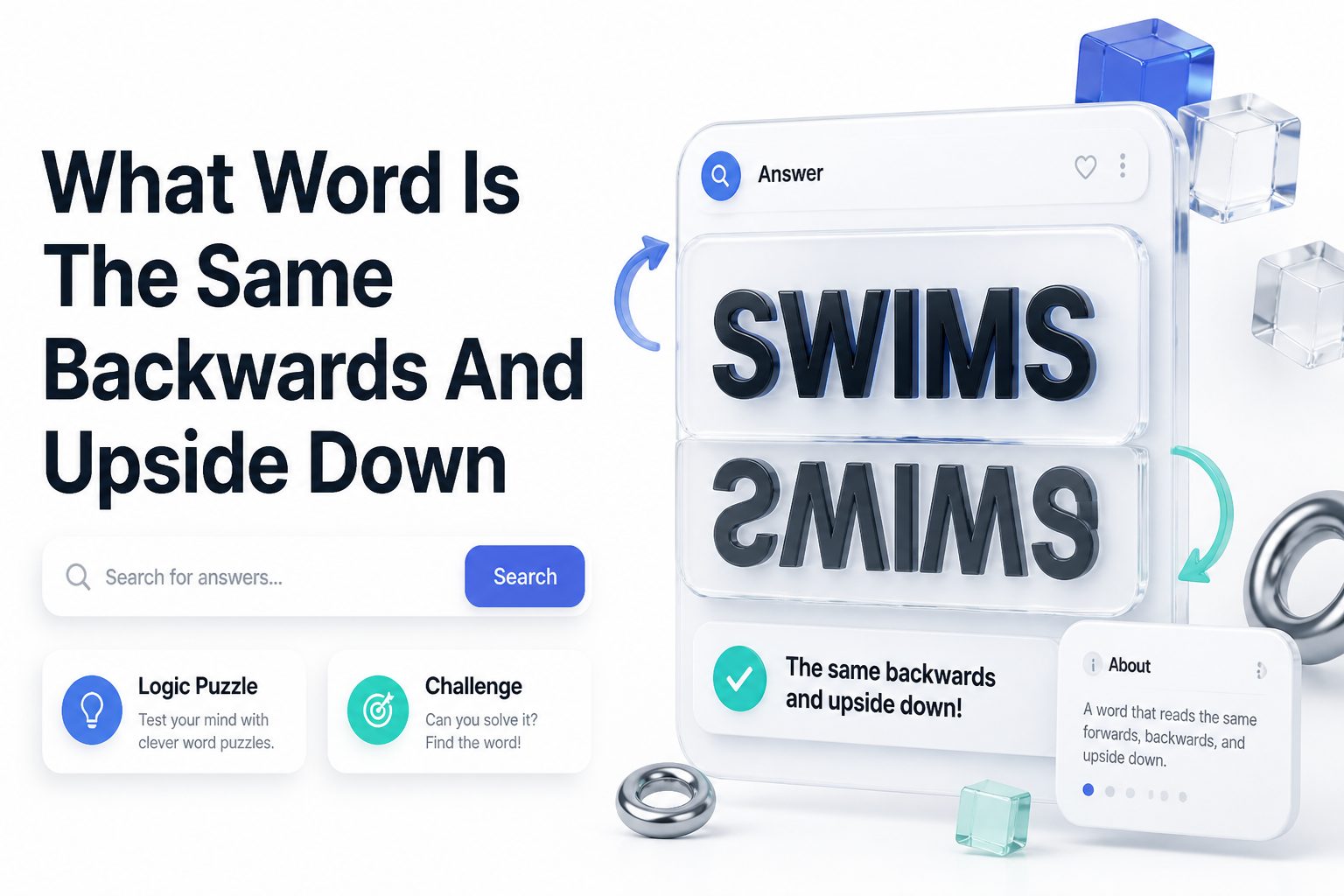
Some people answer SWIMS when asked for an upside-down word. In certain fonts, SWIMS can look like SWIMS after a 180-degree turn because each letter transforms into a matching shape. However, it is not a standard palindrome in spelling.
Other suggestions include SOS, MOM, WOW, and OXO. These may work under specific visual rules, but they do not always meet both requirements. The phrase “same backwards and upside down” makes NOON the cleaner and more reliable answer.
Why SWIMS Is a Common Alternative
SWIMS is popular because it has a clever visual trick. When written in capital letters in certain typefaces, each letter can rotate into another readable form. The whole word may still appear as SWIMS after being turned upside down.
The weakness is that SWIMS is not the same backwards. Backwards, it becomes SMIWS, which is not the same word. So SWIMS is better described as a rotational ambigram, not the strongest answer to this exact riddle.
Important distinctions:
- NOON works as a palindrome and an upside-down word.
- SWIMS works mainly as a rotational ambigram.
- MOM becomes WOW when flipped in many styles.
- SOS is close, but the S shape depends on the font.
- OXO works visually, though it is less common as a standard word.
- Font choice can decide whether an answer feels valid.
How Rotation Differs From Reflection
Turning a word upside down means rotating it 180 degrees. That is not the same as holding it up to a mirror. Rotation changes the top and bottom positions while also reversing the order of letters visually.
Reflection creates a different type of puzzle. Mirror words depend on horizontal reversal, while upside-down words depend on rotational symmetry. The phrase what word is the same backwards and upside down combines both spelling logic and visual rotation.
Why The Riddle Feels Tricky
This riddle feels tricky because readers often mix several ideas at once. They think about backward spelling, mirror images, upside-down text, and letter shape at the same time. The brain wants one rule, but the puzzle uses two.
The answer becomes clearer when the rules are separated. First, check whether the word is spelled the same backward. Second, check whether the word still looks right upside down. NOON passes both tests more neatly than most alternatives.
Quick checklist for solving similar riddles:
- Is the word spelled the same backward.
- Are the letters visually stable when rotated.
- Does the answer require uppercase letters.
- Does the font change the result.
- Is the word a real word.
- Does the clue ask for spelling, appearance, or both.
Best Way to Write NOON for the Puzzle
To make NOON work clearly, write it in uppercase letters. Lowercase noon may still read backward, but the lowercase n is less convincing when flipped. Uppercase lettering removes most of that uncertainty and makes the visual trick easier to see.
A simple, bold, sans-serif font works best. Avoid cursive, italic, or decorative type because those styles can change the shape of N and O. For classroom boards, worksheets, and social media puzzles, plain capital letters are the safest choice.
The Difference Between Real Words and Visual Tricks
Some puzzle answers are real words with strict spelling rules. Others are visual tricks that depend on how the letters are drawn. NOON is satisfying because it is both a real word and a strong visual answer.
This matters when explaining the answer to someone else. If the clue says “word,” a real dictionary word is expected. If it says “text” or “design,” then stylized ambigrams and custom lettering may also be acceptable.
Useful examples by category:
- Strongest answer: NOON
- Palindrome examples: level, civic, radar
- Upside-down visual word: SWIMS
- Short symbolic option: OXO
- Font-dependent option: SOS
- Common misleading option: MOM
Classroom Uses for This Word Puzzle
Teachers often use this riddle to introduce palindromes, symmetry, and visual reasoning. It works well because the answer is short, but the explanation encourages careful thinking. Students can test letters, rotate paper, and compare different fonts.
The activity can also support spelling lessons and geometry connections. A word like NOON shows how language and shape can overlap. For more language puzzle ideas, see [Internal Link: Word Puzzle Activities] as a useful place to continue.
SEO and Search Intent Behind the Phrase
People searching for what word is the same backwards and upside down usually want a quick answer first, then a simple explanation. They may be solving a riddle, helping a child with homework, or checking whether NOON or SWIMS is correct.
Good content on this topic should answer directly before adding context. The best explanation covers palindrome meaning, upside-down readability, font dependence, and alternative answers. That satisfies both casual puzzle solvers and readers who want the reasoning behind the answer.
Common search intent signals:
- Looking for the direct riddle answer.
- Comparing NOON and SWIMS.
- Learning what palindrome means.
- Checking upside-down word examples.
- Finding classroom-friendly explanations.
- Looking for related word games.
How to Explain the Answer to Kids
A simple explanation works best for children. You can say that NOON reads the same from both directions, then show the word on paper and rotate it. Seeing the word turn and still look right makes the idea easier to grasp.
It also helps to compare it with a word that fails. Write CAT, turn it upside down, and ask whether it still works. Then write NOON and repeat the test. The contrast makes the logic visible without a long definition.
How to Make Your Own Upside-Down Words
Start by choosing letters that look similar after rotation. O, H, I, X, S, N, M, and W are often useful, depending on the font. Then arrange them so the reversed order still creates the same or a readable word.
After that, test the word in different typefaces. A puzzle that works only in one decorative font may still be fun, but it should be presented as a design trick. For more examples, visit [Internal Link: Palindrome Word Examples].
Practical steps:
- Choose simple capital letters.
- Favor letters with rotational symmetry.
- Test the word on paper.
- Rotate it 180 degrees.
- Check both spelling and appearance.
- Use a plain font for the clearest result.
Why NOON Is More Reliable Than MOM
MOM is often suggested because it looks symmetrical at first glance. However, when rotated upside down, the M usually becomes W. That means MOM often turns into WOW, which is a different word, even though it creates another readable result.
NOON does not have that problem. The N can remain N in many block styles, and O remains O. Because the spelling also reverses perfectly, NOON gives a more accurate answer to the original wording of the riddle.
When The Answer Might Depend on Interpretation
Some versions of the riddle are worded loosely. If someone asks for a word that looks the same upside down, SWIMS may be accepted. If they ask for one that reads the same backward and upside down, NOON is stronger.
This is why it helps to pay attention to the exact clue. “Backwards” points to spelling order. “Upside down” points to visual rotation. When both are included, the answer should satisfy both conditions, not just one of them.
Quick rule guide:
- If the clue says backwards only, look for a palindrome.
- If the clue says upside down only, look for an ambigram.
- If the clue says both, test spelling and rotation.
- If the clue mentions capital letters, font matters less.
- If the clue is informal, more than one answer may be accepted.
Conclusion
The answer depends on the exact wording, but NOON is the most reliable choice for what word is the same backwards and upside down. It works because it is a palindrome and can also remain visually readable after a 180-degree rotation in simple uppercase lettering.
Other words, such as SWIMS, SOS, MOM, and OXO, may appear in similar puzzles, but they usually rely more heavily on font style or only satisfy part of the clue. NOON stands out because it balances spelling logic with visual symmetry. That is why it is commonly accepted in riddles, classroom activities, and word puzzle discussions. When explaining it, write the word in capital letters, use a plain block font, and rotate the page. The answer becomes clear in seconds, and the small puzzle becomes a neat lesson in language, shape, and perspective.
FAQ
What is the best answer to this riddle?
The best answer is NOON. It reads the same backward and can look the same upside down in uppercase block letters. Its simple spelling and symmetrical letter shapes make it the clearest solution.
Is NOON a palindrome?
Yes, NOON is a palindrome because its letters appear in the same order forward and backward. The word starts and ends with N, with two O letters in the middle.
Why do some people say SWIMS?
SWIMS can look the same upside down in certain fonts, so people often suggest it. However, it is not spelled the same backward, which makes it less accurate for this exact riddle.
Does the font affect the answer?
Yes, font style can affect upside-down readability. NOON works best in uppercase block lettering. Decorative, cursive, or slanted fonts may change how the letters look when rotated.
Are there other words like NOON?
There are similar examples, but few work as neatly. SOS and OXO may work visually, while civic and level are palindromes. NOON remains the strongest answer because it satisfies both parts.
0 Comments